
Project Management Books
Thought leadership that shapes professional practice.
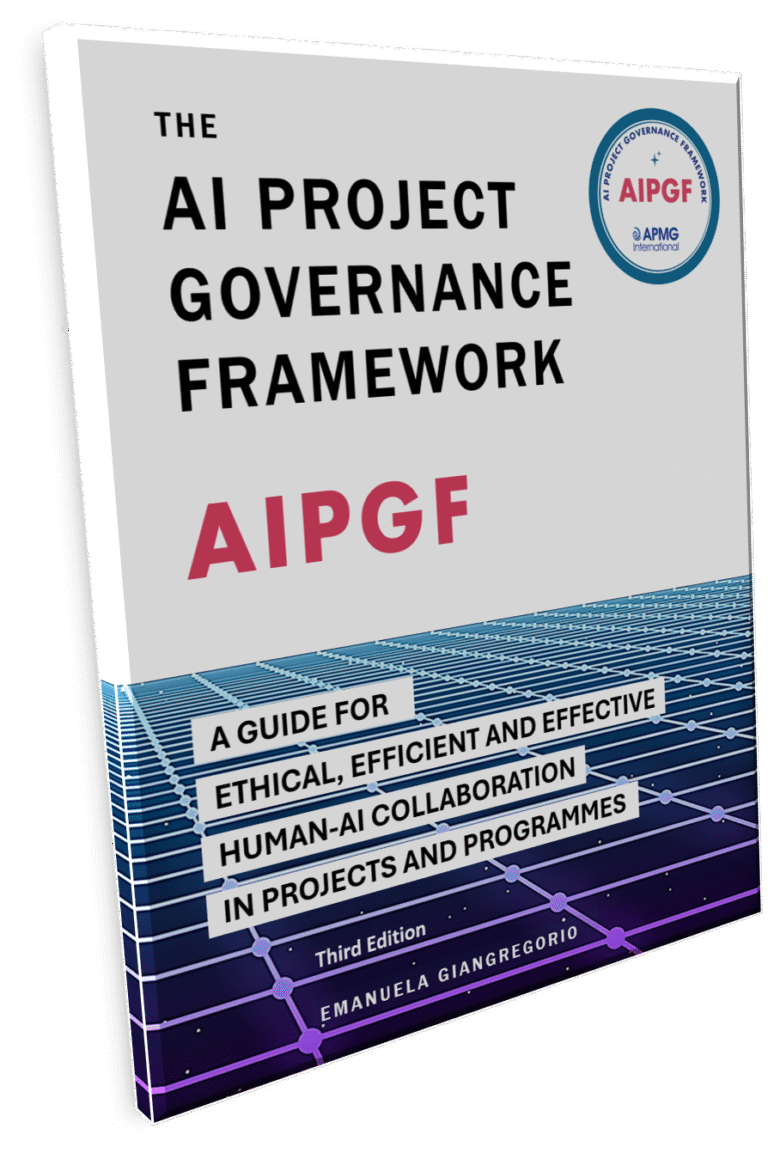
The AI Project Governance Framework (AIPGF): A Guide or Ethical, Efficient and Effective Human-AI Collaboration in Projects and Programmes
The AI Project Governance Framework (AIPGF) provides project and programme teams with a practical means of governing AI use, ensuring its benefits are realised and its risks are responsibly managed.
- Integrates with the project method already in use, whether Agile, PRINCE2®, PMBOK® or a hybrid approach.
- Scales to projects and programmes of varying size, complexity and risk, and to differing levels of AI adoption and AI governance maturity.
- Offers a clear method for facilitating and evidencing ethical, efficient and effective AI use in projects and programmes.
By adopting the Framework, organisations can govern AI use consistently across their project portfolio as AI adoption scales and tools evolve. The accompanying AI Project Governance Capability Maturity Model (AIPG-CMM) enables them to benchmark AI governance maturity and plan continuous improvement.
The Framework is supported by an accredited certification pathway at Foundation and Practitioner levels, with APMG International.
AIPGF Chapter Summary:
Chapter 1: Introduction – Sets out why the AIPGF exists: confidence in AI on the ground is built by practical governance, not by policy alone. It introduces the Framework’s purpose, its intended readers and how to use the book. It positions the AIPGF alongside ISO/IEC 42001 and the wider standards and regulatory landscape.
Chapter 2: AI in Project Management – Surveys what AI can and cannot do for project delivery: the efficiency gains, the tool landscape from basic AI assistants to agentic systems, and the dilemmas AI use creates. It closes by looking into the future of AI in project management, including AGI and ASI, and makes the case for governance that holds as the technology evolves.
Chapter 3: Overview of the AIPGF – Presents the Framework’s architecture: the six Elements spanning mindset and method, and the three Life Cycle Stages of Foundation, Activation and Evaluation. It maps the AIPGF to PRINCE2Ò, PMBOKÒ and iterative delivery including Scrum, and closes with a one-page quick reference (Figure 12).
Chapter 4: Key AIPGF Roles and Responsibilities – Defines the human roles that govern AI use: the Core Roles required on every AI-assisted project, the conditional roles engaged as size, complexity and risk demand, and the Additional Roles providing strategic and specialised oversight.
Chapter 5: AIPGF Principles – Explains why the foundational Principles anchor the Framework where rules would date, and unpacks the three: Human-Centricity, Transparency and Adaptability. Each is developed with its rationale and its practical implications for AI-assisted projects.
Chapter 6: AIPGF Core Values – Translates the Principles into five Core Values that shape the mindset of AI-assisted project work: Accountability, Sensibility, Collaboration, Curiosity and Continuous Improvement. Each value is explored with its meaning in an AI context and the attitudes it asks of project professionals.
Chapter 7: AIPGF Core Behaviours – Makes the Core Values observable by suggesting three Core Behaviours for each, fifteen in all. These are offered as a flexible reference for embedding the values in daily project work rather than a rigid checklist.
Chapter 8: AIPGF Stage 1: Foundation – Unpacks the first Life Cycle Stage, which makes AI assistance a deliberate decision. It covers the Foundation Aim, Activities and Deliverables, including the AI Assistance Plan, Data Readiness Assessment and AI Assistance Risk Register. It resolves where Foundation begins when a project is fronted with a business case.
Chapter 9: AIPGF Stage 2: Activation – Unpacks the second Stage, which turns the approved AI Assistance Plan into governed day-to-day practice throughout delivery. It covers monitoring of tools, data boundaries, risks and issues, the living updates to Foundation artefacts, and the AI Usage Report.
Chapter 10: AIPGF Stage 3: Evaluation – Unpacks the third Stage, which assesses whether AI delivered the intended value, was used within agreed boundaries and the quality of the human-AI collaboration effort. Evaluation recurs during delivery as well as at close, and its findings feed future stages, future projects and the organisation’s wider AI governance.
Chapter 11: Embracing the Spirit of the Framework – Concerns how the Framework should be applied: by implementing its intent with judgement and proportionality rather than complying with it to the letter. It shows what spirit-led adoption looks like in practice.
Chapter 12: Assessing Capability Maturity – Introduces the AIPG Capability Maturity Model (AIPG-CMM), tracing the maturity model tradition from the Software CMM to today’s AI maturity models. It sets out the AIPG-CMM’s Pillars, maturity levels and provides continuous improvement guidance for organisation-wide adoption of the Framework in their project environments.
Chapter 13: Tailoring the AIPGF to Different Contexts – Demonstrates the Framework’s adaptability through three case studies spanning different project sizes, sectors and AI maturity levels, showing how the Elements, Stages and roles scale to fit the context without losing their intent.
Chapter 14: Overcoming AI Adoption Challenges in Projects – Addresses the practical obstacles to ethical, efficient and effective human-AI collaboration in projects, from resistance and skills gaps to tool integration, capability drift, data governance and maintaining accountability, each with proportionate suggestions.
Appendix A: Positioning AIPGF alongside AI Standards and Regulation – Positions the Framework alongside ISO/IEC 42001, the NIST AI Risk Management Framework, the EU AI Act and the OECD AI Principles, and compares it with the Project Management Institute’s 2026 AI standard, explaining how the AIPGF activates these instruments at project and programme level.
Appendix B: AIPGF Certification Pathway – Describes the APMG-accredited certification scheme built on this book: the Foundation and Practitioner levels, what each examines and how to prepare.
Appendix C: Project Manager Core Skills in an AI World – Considers the enduring human skills project managers need as AI assistance grows, and how the profession’s value shifts as administration is increasingly delegated to technology.
Appendix D: References and Further Reading – Lists the external sources cited in the book, organised by chapter, with verified references for the standards, regulations, research and maturity models discussed.
Practical Project Management: Manage Project Successfully with this Comprehensive Toolkit and Templates
Based on Emanuela’s internationally best-selling Practical Project Management course, this book condenses best practice project management methods into a practical and useful guide. Learn from her real-world experience and get started on your projects with a comprehensive set of tools and templates covering the entire project life cycle.
Armed with the benefits of the various methods and tools, you should be able to convince colleagues of their importance to deliver projects successfully. If you aim to complete a project qualification such as PRINCE2, Agile or the Project Management Institute’s PMP, this book is highly recommended as pre-reading to first understand all key project management concepts and their practical implementation.
This book introduces you to the concept of project management and walks you through the full project life cycle. It follows a logical thinking approach and provides worked examples. If you follow Emanuela’s teaching in this book, you will be equipped to deliver projects more confidently, professionally and successfully.
You will learn how to adapt the approach to different types of projects in terms of their nature and complexity.
Note: This book does not cover AI in project management. It is recommended here for those who wish to take the AIPMP certification and need to brush up their project management knowledge.
Project Management Templates Included in the Book:
- Project Brief
- Project Business Case
- Project Plan
- Governance Structure
- Responsibility Matrix
- Risks Management Log
- Stakeholder Mapping
- Project Communication Plan
- Project Actions Tracker and Gantt Chart
- Task Dependency Mapping
- Budget Breakdown and Tracker
- Kick-Off Meeting Agenda
- Scope Change Management Log
- Issues Management Log
- Status Report
- Benefits Realisation Review
- Lesson Learnt Log
- Project Manager Skills Self-Assessment
Practical Project Stakeholder Management: Methods, Tools and Templates for Comprehensive Stakeholder Management
One of the most challenging aspects on projects is managing stakeholder expectations and getting their commitment and buy-in to the project. Written by an experienced Project Management consultant, trainer and coach, this book will provide you with the know-how, techniques and templates you need to conduct robust stakeholder management on your projects. The approach described here is scalable. On large complex projects, you should perform rigorous and robust stakeholder management. On smaller, less complex projects, you need to apply the spirit of the method.
Stakeholder engagement is one of the most important keys to successful projects. This book provides an essential and up-to-date toolkit for project managers to identify, assess and engage their stakeholders. It is packed with free-to-use tools and templates that experienced project managers use to successfully manage their stakeholders.
Note: This book does not cover AI in project management. It is recommended here for those who wish to take the AIPMP certification and need to brush up their project management knowledge.
Project Stakeholder Management Templates Included in the Book:
- Influence-Involvement Grid
- Influence-Involvement Grid Showing Level of Interest
- Influence-Involvement Grid Showing Interest and Impact
- Influence-Involvement Grid Showing Interest, Impact and Support
- Stakeholder Resistance Mapping
- Stakeholder Assessment Table Example
- Stakeholder Value Mapping Example
- Project Stakeholder Engagement Meeting Agenda Example
- Stakeholder Engagement Template – Worked Example
- Project Stakeholder Expectations Alignment Template
- Project Stakeholder Communication Plan Template
- Project Stakeholder Communication Plan Example
- RACI Matrix Example
- Stakeholder Mapping Across Stages
- Stakeholder Management Effectiveness Review Template
Writing Compelling Business Cases: Methods, Tools and Templates for Writing and Presenting a Brilliant
Writing a compelling business case is both an art and a science. For professionals tasked with this critical responsibility, the challenge lies in creating a document that cuts through complexity while delivering crystal-clear insights. Decision-makers need concise, powerful narratives that illuminate the path forward—not verbose documents that obscure key information.
Drawing from years of consulting experience working with professionals across industries, this guide offers a practical approach to business case development. It recognizes the real-world struggles many face: outdated templates, unclear guidance, and the pressure to communicate complex ideas effectively.
Unlike standard reference materials, this book provides a comprehensive toolkit that goes beyond theoretical frameworks. It’s designed for everyone from emerging entrepreneurs to seasoned corporate strategists, offering techniques that transform business case writing from a dreaded task to a strategic advantage.
The guidance within these pages does more than just teach writing skills. It equips you with a systematic approach to crafting narratives that genuinely resonate with decision-makers. Whether you’re proposing a small initiative or mapping out a complex organizational strategy, you’ll find actionable insights that cut through the noise.
For professionals pursuing formal business case qualifications like Better Business CasesTM , this book serves as an invaluable companion. It offers perspectives and practical techniques that complement formal training, providing depth and practical wisdom that traditional coursework often misses.
More than just another business book, this is a field guide—a resource that demystifies the art of persuasive business communication and empowers professionals to tell their organizational stories with confidence and clarity.
When you follow Emanuela’s guidance in this book, you will be equipped to write and present compelling business cases more confidently, professionally and successfully.
Note: This book does not cover AI in project management. It is recommended here for those who wish to take the AIPMP certification and need to brush up their project management knowledge.
Project Business Case Writing Templates Included in the Book:
- Benefits Tracker
- Project Business Case Template
- Clarification Questions Log
- Stakeholder Mapping
- Stakeholder Insights Analysis
- Strategic Fitness Scorecard
- Ideas Comparison Scorecard
- Simple Options Appraisal
- TCO Options Comparison Table
- Simple Options Appraisal with x-year TCO
- Scored Options Appraisal Showing TCO
- Impact v Net Position Chart
- Weighted Scored Options Appraisal Showing TCO
- Investment Appraisal
- Business Case RACI Matrix
- Simple Risk Assessment
- Residual Risk Assessment
- Business Case Review Checklist
- Business Case Assumptions Log
